Category: Uncategorized
How To Start Your Own Business. Part 7
Thinking of starting a business, but not sure what you need to know? Begin your journey here with my basic guide to business start-ups. In my role as Editor for The Business Show and Business Startup, I have talked with literally thousands of business owners and entrepreneurs about what they really need to know, not what a business guru thinks they need to know. This series is the result. Today’s blog looks at the thorny issue of tax.
How Business Tax Works
Any business has to pay tax, but different kinds of business have different kinds of tax. The following information is correct to the best of my knowledge at the time of writing (Nov 2014), but tax is constantly changing, so please check the current information at www.hmrc.gov.uk
Sole Trader and Partnership
The income tax rates for any income that isn’t from savings are 20 per cent up to £37,400, 40 per cent between £37,401 and £150,000 and 50 per cent over £150,000. Individuals with income under £100,000 are entitled to a personal allowance or a tax-free amount, which is presently £8,105. You only pay tax on income above this threshold.
If you’re self-employed, you’ll also have to pay Class 2 (£2.50 per week) and Class 4 National Insurance. Class 4 contributions are a percentage of the annual business profit, only applicable after profits reach £7,225.
Both of these payments are done through self-assessment, where you must file a tax return at the end of every tax year. You’ll need to set up the National Insurance contribution records by registering with HMRC as soon as you start the business.
Limited Companies
Corporation Tax is a tax on the profits of limited companies. The main rate of Corporation Tax is 25 per cent, but companies with profits less than £300,000 can pay Corporation Tax at 20 per cent. New companies need to register their details with the appropriate Corporation Tax Office within three months of incorporation.
VAT
Most business to business or business to customer transactions attract Value Added Tax (VAT) at 20 per cent, although some items are taxed at 5 per cent or even a zero rate, while others are entirely exempt. New businesses only become liable for VAT after the taxable turnover for the previous 12 months exceeds £73,000.
Import VAT and Duty
Businesses importing and exporting products outside the European Union are liable for import VAT and duty. The rate depends on the product and country.
Exemptions and relief
New businesses can benefit from tax allowances and relief, such as small business rate relief.
- Capital allowances relief provides Corporation Tax relief for Limited companies buying assets such as computers, vehicles and furniture during the first year of business.
- Research and Development Relief allows businesses to deduct their actual expenditure on most research and development cost from their Corporation Tax liability. SMEs can choose a tax credit instead of tax relief.
- Working Tax Credit is aimed at people over 25-years old who work more than 30 hours a week on a low income. It varies with income and could be very useful for start-up entrepreneurs who are just getting going.
- Enterprise zones offer a 100 per cent tax exemption for five years for start-ups within their geographical area, or businesses relocating there.
- The Enterprise Investment Scheme offers Income Tax relief of 30-50 per cent for anyone investing up to £200,000 in new ventures. Any gains are also exempt from Capital Gains Tax if they are reinvested in new ventures in the same tax year.
Tax is a confusing area and subject to change, so please check your position before making any decisions or taking any action. The information in this blog is correct to the best of my knowledge at time of publication, but I cannot accept any responsibility. It’s your job to check the latest info. If you’re at all uncertain, please seek professional advice.
Useful Links:
NEXT: Get A Website
If you find the series – or any of the articles in it – useful, please share them via LinkedIn, Facebook, Twitter, or your own blog. I’d really appreciate it, thanks. If you need professional copywriting for anything from your first business plan to marketing collateral and press releases, I’d love to hear from you. Get in touch today to find out how I could help your business.
How To Start Your Own Business. Part 6
Thinking of starting a business, but not sure what you need to know? Begin your journey here with my basic guide to business start-ups. In my role as Editor for The Business Show and Business Startup, I have talked with literally thousands of business owners and entrepreneurs about what they really need to know, not what a business guru thinks they need to know. This series is the result. Today’s blog looks at how the different kinds of investment work.
How To Attract Investment
Whether your business needs funding to get off the ground, or grow to the next level, the options are basically the same. Here, we’ll look at how each of the main routes to funding works, as well as the benefits of each.
Investment finance
This is only open to limited companies, not sole traders. Sell part of your business (shares) to an investor, who will take a share of any profits or losses. Investors can bring new skills, will share the risks with you and you won’t need to pay any interest or repay a loan. Having an investor can be demanding, expensive and time-consuming, and you could own a smaller part of a larger concern, while you may have to consult your investors before making management decisions. But they do bring the benefit of all their experience to you business, as they are literally invested in your success.
Loans
With any loan, you will need to repay the original loan amount, plus interest. They can be secured on property, with fixed or variable interest rates. Loans could be used for assets such as a vehicle or equipment, or for start-up capital and they’re available from banks or the government.
Grants
You can get a grant from the government, the European Union, local councils and charities. There’s no need to repay anything, but there’s a lot of competition and they’re usually awarded for a specific purpose or project. Charitable projects, or those of benefit to the community, are most successful.
Overdrafts
They may be useful in a pinch, but overdrafts should only ever be for the short term. You will be charged interest and you may be charged fees. Other options are usually more favourable.
Invoice financing
This method can be useful for trading companies with outstanding invoices who need to access the cash they represent. A third party buys your unpaid invoices. Factoring usually involves an invoice financier managing your sales ledger and collecting money owed by your customers. The invoice financier will buy the debt owed to you by your customer and give you a percentage – usually around 85%. They collect the full amount from your customer and pay the remaining balance to you. You then pay the financier’s interest and fees. Invoice discounting means that you continue to chase the client for payment. Both options are usually only available on commercial invoices and don’t apply if you sell direct to the public.
Leasing and asset finance
Leasing or renting assets, such as machinery or office equipment, saves the initial costs of buying them outright. Interest rates are usually fixed, but prices can be higher than buying outright. Less risk than a bank loan, because if you can’t make payments you’ll lose the asset, but not your home. You can’t claim capital allowances on a leased asset if the lease period is less than five years (or seven years in some cases).
Crowdfunding
A relatively new phenomenon, crowdfunding can be a great way for unusual projects to get funding. The premise is that you appeal to the public to fund your business, usually through a website. Of course, you need to offer the individuals something in return, whether that’s financial profit, or a discounted price on a finished product. Crowdfunding has been used to fund everything from music albums and videogames to new technology. This sector is currently not regulated.
Useful Links:
UK Business Angels Association
Office For National Statistics
NEXT: How business tax works
If you find the series – or any of the articles in it – useful, please share them via LinkedIn, Facebook, Twitter, or your own blog. I’d really appreciate it, thanks. If you need professional copywriting for anything from your first business plan to marketing collateral and press releases, I’d love to hear from you. Get in touch today to find out how I could help your business.
How To Start Your Own Business. Part 5
Thinking of starting a business, but not sure what you need to know? Begin your journey here with my basic guide to business start-ups. In my role as Editor for The Business Show and Business Startup, I have talked with literally thousands of business owners and entrepreneurs about what they really need to know, not what a business guru thinks they need to know. This series is the result. Today’s blog looks at the various formats your business could take, how they differ and what your legal requirements would be for each.
Which Format Should You Choose For Your Business?
You’ll need to decide which legal structure is right for your business before you register and start trading. This will affect what paperwork you need to fill in to get started, the taxes you’ll have to pay, how you can take profit from your business, and your responsibilities if your business makes a loss. This is also a good time to consider what kind of business insurance you may need. There are three main kinds of business format, so let’s look at each in turn.
Sole trader
You’ll run your own business as an individual, even if you employ staff. You can keep all your profits after tax. You’ll also be personally responsible for any losses, bills for things like stock or equipment, and keeping records of your sales and spending. You have to register with HMRC, send a self-assessment tax return every year, pay Income Tax on the profits your business makes, pay National Insurance and register for VAT if you expect your business’ takings to be more than £79,000 a year.
Limited company
This organisation is responsible in its own right for everything it does, so its finances are separate to your personal finances. After Corporation Tax, any profit is owned by the company, which can then share its profits. Every limited company has ‘members’, who own shares in the company. These can be people or organisations. The shareholders’ responsibilities for the company’s financial liabilities are limited to the value of shares that they own but haven’t paid for. Directors are responsible for running the company and often own shares, but don’t need to. They aren’t personally responsible for debts the business can’t pay, as long as they haven’t done anything illegal.
You must set up the company with Companies House and let HMRC know when the company starts business activities. The company must register for VAT if you expect its takings to be more than £79,000 a year. Every financial year, the company must complete statutory accounts, send Companies House an annual return, and send HMRC a Company Tax Return. The director must fill in a self-assessment tax return every year, and pay tax and National Insurance through the PAYE system if drawing a salary from the company.
Partnerships
You and your business partner (or partners) share responsibility for your business – and the profits. Each partner pays tax on their share of the profits. You’re personally responsible for your share of any losses and bills. A partner can be a limited company, but you must have a ‘nominated partner’, who must register the partnership with HMRC, keep records and manage tax returns. All partners need to send a personal self-assessment tax return every year, pay Income Tax on their share of the profits and pay National Insurance. The partnership must register for VAT if you expect its takings to be more than £79,000 a year. There are also limited partnerships and limited liability partnerships, where limited partners aren’t personally liable for business debts (unlike General Partners), as their liability is limited to the amount of money they invest in the business.
Only you can decide which format is right for you. There are pros and cons to each and different businesses can benefit in different ways, so the smart move is to talk to a professional with experience of the implications of your decision. Accountants are good at this, or you could find an experienced business mentor.
Useful Links:
NEXT: How to attract investment
If you find the series – or any of the articles in it – useful, please share them via LinkedIn, Facebook, Twitter, or your own blog. I’d really appreciate it, thanks. If you need professional copywriting for anything from your first business plan to marketing collateral and press releases, I’d love to hear from you. Get in touch today to find out how I could help your business.
Well, That Was A Busy October/November!
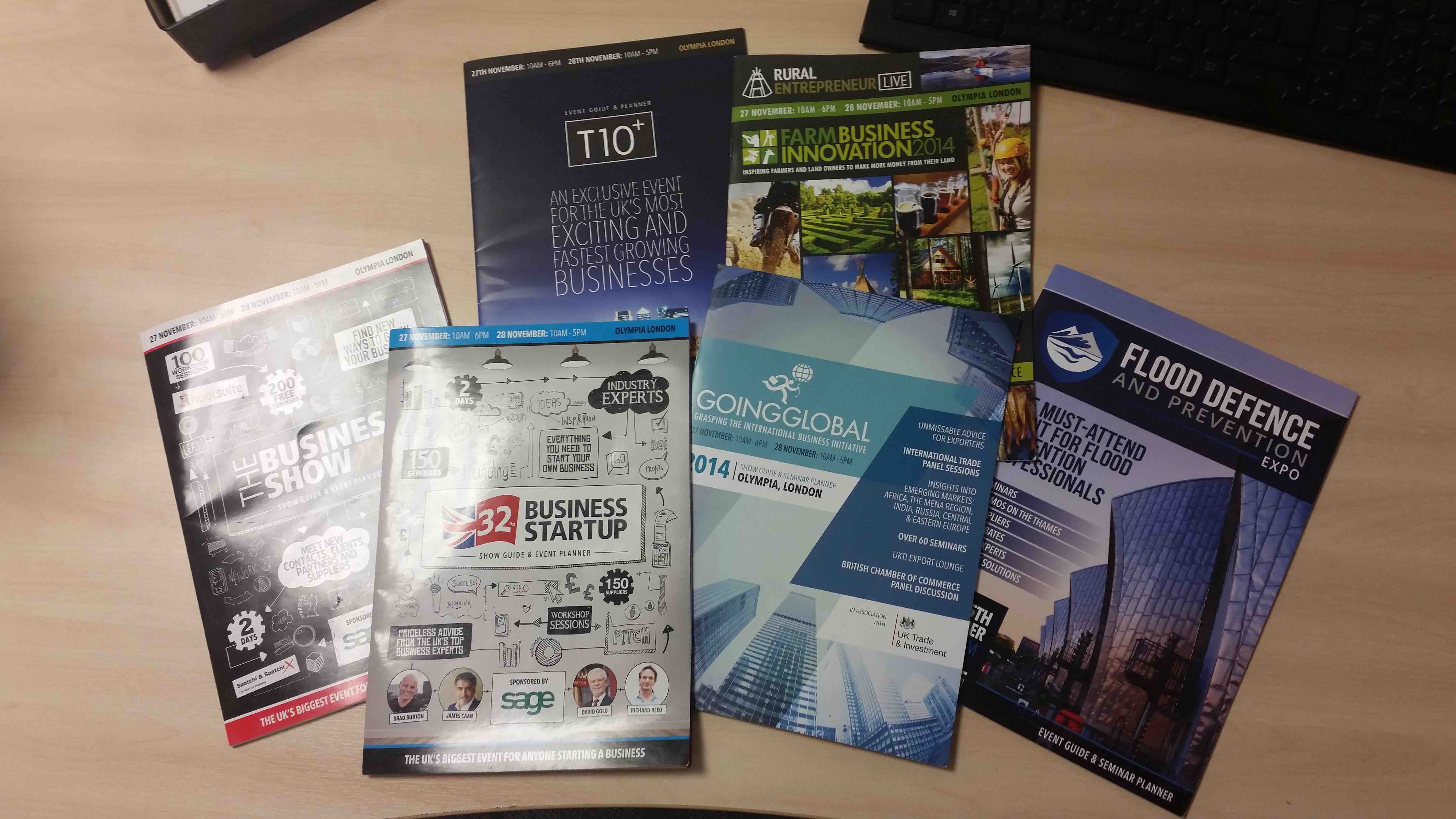
I’ve been flat out for the last six weeks or so, pulling together the print show guides for one of my clients, Prysm Group, the UK’s biggest independent event organisers.
The complete set comprises a ‘mere’ 224 pages of persuasive copywriting, proofreading, editing and project management for some of the UK’s leading trade events, including Britain’s biggest business exhibition and conference, The Business Show.
The job has certainly kept me on my toes – including expanded digital publications – but with the events being held in the next two weeks, the end is in sight and my thoughts are already turning to my next challenge…
New Testimonial
I just received some very kind words from one of my clients:
“Friendly. Reliable. Passionate about his craft. What’s not to like? Steve’s work reads so effortlessly, but he takes great care that every word pulls its weight. He always seems to understand what I want to achieve, whether that’s a press release, website or social media and he always gets it right first time. Steve’s work as a copywriter is integral to my content marketing strategy, where he has successfully raised our profile and contributed to a clear upswing in sales. With results like that, why would I use anyone else? I look forward to working with Steve in the future.”
Lee Archer, Director, Elite Sports Performance
How To Start Your Own Business. Part 4
Thinking of starting a business, but not sure what you need to know? Begin your journey here with my basic guide to business start-ups. In my role as Editor for The Business Show and Business Startup, I have talked with literally thousands of business owners and entrepreneurs about what they really need to know, not what a business guru thinks they need to know. This series is the result. Today’s blog looks at what you need to include in your business plan and why it’s useful for more than just attracting investment.
How To Write A Brilliant Business Plan
The most visible purpose of a business plan is to attract investment, but it will also clarify your thinking as you plan your business, and serve as a measuring stick as your business grows. There’s no single format, as your plan will be personal to you and your business, but remember that it needs to be readily understood by someone with no knowledge of your business idea.
Your business plan should include:
1) An executive summary, which should broadly explain what your business will do and why; where your businesses opportunities are; if you or your team have a track record in the sector or in business; financial projections; costs and funding needed. Busy investors may not read more than this before they dismiss your proposal, so make it snappy!
2) A detailed background to your business, stating what it is, what it does, what its advantages are, how it will stand out, what will make people buy your product and the business’ present position.
3) Explain your market analysis, based on research. Speak to potential customers about their wants and needs, whether they are being met and if not, why not. Explain how your product or company can take advantage of any perceived shortfall.
4) List your competitors, their areas of strength and weakness, explaining how you intend to adopt their customers, based on considerations including cost, customer service and advancement.
5) Explain your sales strategy, including marketing, how you will actually sell your product, generate growth and – most importantly – projected profit margins. If you have existing or interested customers, detail them here.
6) Specify the relevant experience and skill sets of anyone in your team, remembering that if anyone is investing in your business, they are investing in you. It’s all about reducing the risk and increasing the likelihood of success.
7) Finally, the meat of the plan: the financials. This should include realistic forecasts regarding sales, cashflow forecasts, three-year profit-and-loss forecasts, break-even analysis, and projected balance sheets.
And it can’t hurt to include a conclusion that will wow any investors by recapping all the reasons you’ve previously covered in more detail explaining why your business is a winner…
Not only is it a good idea to ask someone to look over your documentation when it is finished, but why not involve one or more professionals in creating it? An accountant can obviously help you get the financials straight, but a business mentor could have valuable input about what an investor may be looking for. And of course, a professional copywriter could help you present your business to its maximum potential. Persuasive prose doesn’t need to scream ‘Buy me!’ to be effective…
Useful Links:
NEXT: Choosing a business format
If you find the series – or any of the articles in it – useful, please share them via LinkedIn, Facebook, Twitter, or your own blog. I’d really appreciate it, thanks. If you need professional copywriting for anything from your first business plan to marketing collateral and press releases, I’d love to hear from you. Get in touch today to find out how I could help your business.
How To Start Your Own Business. Part 3
Thinking of starting a business, but not sure what you need to know? Begin your journey here with my basic guide to business start-ups. In my role as Editor for The Business Show and Business Startup, I have talked with literally thousands of business owners and entrepreneurs about what they really need to know, not what a business guru thinks they need to know. This series is the result. Today’s blog looks at why you need to understand your customer so that you steer your new business in the right direction from the beginning.
Don’t Make A Move Until You’ve Researched Your Market
Before starting any business, it’s a good idea to find out if anybody will want to buy what you’re selling. And if they don’t, now’s the time to make changes so that your product definitely has a market before you’ve incurred any costs. This is normally done by a combination of primary and secondary research.
Primary research
This means talking to your potential customers about their spending habits, how they view your competition and what they think of your product. You can do this in person, over the phone, with a questionnaire, or online. Market stalls or pop-up shops can make for a good chance to speak with your customers about your product. Questions could include:
- What factors do you consider when purchasing this product or service?
- What do you like or dislike about similar products or services?
- What would you like to improve?
- What would you pay?
Secondary research
This analyses published data so that you can identify competitors, set benchmarks and identify target demographics. These will be your potential customers, defined by lifestyle, behaviour and age.
When you have a prototype product or service, show it to a focus group of around eight people and ask for their feedback. Then act upon any consensus. Find out what people would pay, but also what they see as the benefits and what their trigger to purchase would be.
This is when you should also find out about your competition, how customers perceive them and how you can ensure your business stands out from the crowd.
The more thorough your market research, the more informed your decisions will be. Not only will this help you steer your business in the right direction from the start, but it will also impress potential investors if you seek funding, encouraging them to see you as a safer risk.
Useful Links:
NEXT: How To Write A Brilliant Business Plan
If you find the series – or any of the articles in it – useful, please share them via LinkedIn, Facebook, Twitter, or your own blog. I’d really appreciate it, thanks. If you need professional copywriting for anything from your first business plan to marketing collateral and press releases, I’d love to hear from you. Get in touch today to find out how I could help your business.
How To Start Your Own Business. Part 2
Thinking of starting a business, but not sure what you need to know? Begin your journey here with my basic guide to business start-ups. In my role as Editor for The Business Show and Business Startup, I have talked with literally thousands of business owners and entrepreneurs about what they really need to know, not what a business guru thinks they need to know. This series is the result. Today’s blog looks at the different ways you can make sure nobody steals your great idea.
How To Register Your Idea
Many start-up are based upon an innovative idea or product and you need to ensure that nobody else can steal it from under your new business before it has a chance to establish itself. This is usually referred to as your intellectual property. To protect it, this needs to be something unique that you have created. It could be a new product you’ve invented, a design, brand or logo, a written work, photography, a song or a piece of software, amongst other things. The protection stops anyone using what you’ve created without your permission and enables you to charge others for the right to use it.
There are different types of protection, depending on what you’ve created. These are the most common:
Copyright
Artistic works are protected by copyright. Just by creating something, you own the copyright, but it can help to use the © symbol, your name and date of creation anytime it’s seen. A good tip is to mail yourself hard copy of your creation (preferably signed for) and leave the envelope unopened when it arrives. This can be very persuasive if you need to assert your copyright in law at a later date.
Patents
Inventions are protected by patents. It can take up to four years for a patent to be granted and mistakes are commonplace, which is why a lot of people use patent attorneys. The cost is around £250 without an attorney, more with their fees.
Trademarks
A trademark is usually the logo that makes your brand recognisable; registering it with the Intellectual Property Office (IPO) means you can prevent anyone using it without your permission and lasts 10 years in the country of registration.
NEXT: The Importance Of Market Research
If you find the series – or any of the articles in it – useful, please share them via LinkedIn, Facebook, Twitter, or your own blog. I’d really appreciate it, thanks. If you need professional copywriting for anything from your first business plan to marketing collateral and press releases, I’d love to hear from you. Get in touch today to find out how I could help your business.
“I Think What You’ve Done Is Perfect!”
Can there be any sweeter words for a freelance creative to hear from a client?
Being a freelance copywriter is sometimes like being a cross between William Shakespeare, David Ogilvy and Mystic Meg. You need the dexterity to make words dance and the business acumen to make them convert, as well as the ability to intuit which will be the winning approach for each client… Often before they even decide their own objectives!
It’s a unique set of skills that I’ve built up over the last decade-and-a-half and I’m still adding new tools to my creative toolbox. I love the challenge and spend hours crafting perfect prose for my clients that seems effortless to their customers. And, as happened yesterday, it’s very much appreciated when a client takes the time after receiving my work to get in touch to say, “I think what you’ve done is perfect!”
How To Start Your Own Business. Part 1
Thinking of starting a business, but not sure what you need to know? Begin your journey here, with my basic guide to business start-ups.
In my role as Editor for The Business Show and Business Startup, I have talked with literally thousands of business owners and entrepreneurs about what they really need to know, not what a business guru thinks they need to know. This series is the result.
Every Monday, Wednesday and Friday, I’ll post a new article in the series, covering a different area of business that every start-up or entrepreneur should know. Each part of the series will look at a different topic; from working out whether your idea will be profitable to deciding on your business structure, getting funding, business tax and who to turn to for advice.
You won’t find answers to all your questions here – there are hundreds of books and websites for every individual topic, after all! What this series will do, however, is give you an overview of the areas you should consider, with some good ideas to get you started.
I’ve approached this series in what seems like a logical order in terms of what you should consider when, but if there’s one thing my experience has taught me, it’s that every business is different! Take what works for you, leave the rest and don’t be afraid to shake it up into whatever shape fits your business!
So what can you expect to cover in the coming weeks? The topics I have planned are:
- Register Your Idea
- Research Your Market
- Write A Business Plan
- Set Up Your Business
- Get Funding
- Tax
- Get A Website
- Marketing
- Employing People
- Call In The Professionals!
I hope you find the series useful. Please, please do your research; read several forums and meet successful local business owners – and listen to what they say! If these articles inspire you, or you found the advice valuable, I’d love to hear from you. And when your business needs a copywriter? Drop me a line…
NEXT: How To Register Your Idea
 Steve Takle
You must be logged in to post a comment.